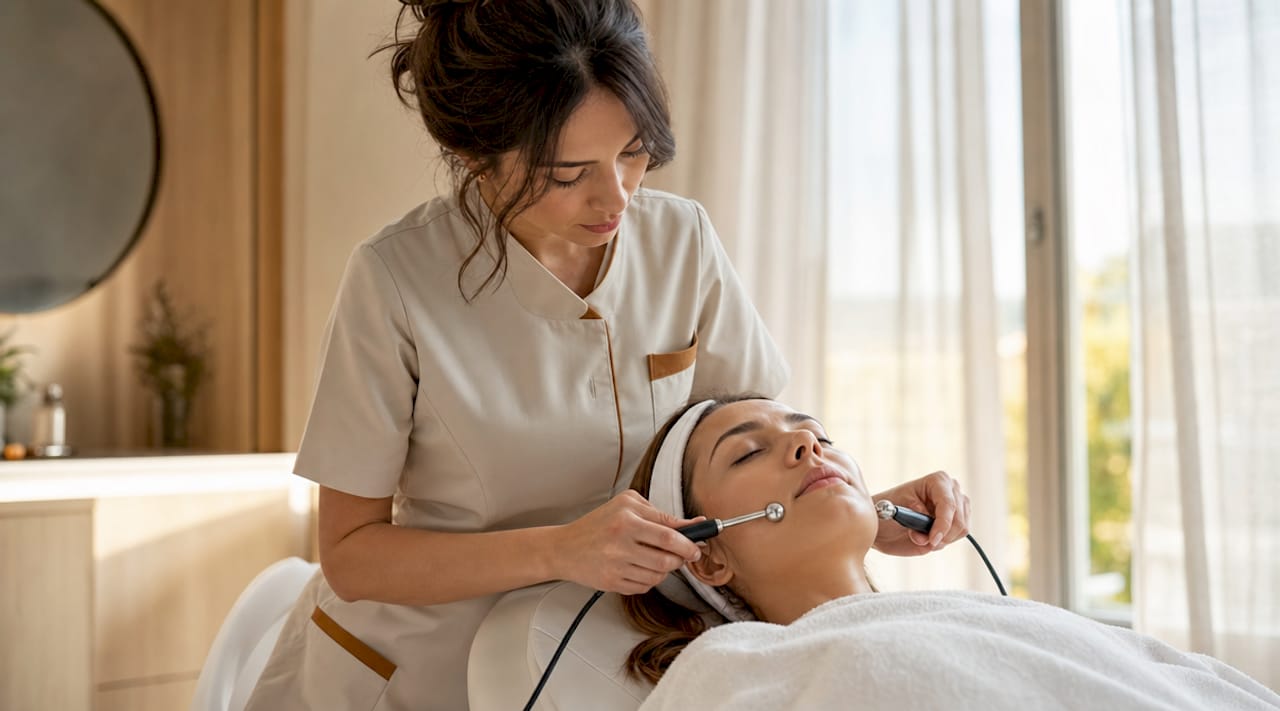
Clinical trials for beauty devices are controlled scientific studies that objectively verify whether a device is safe and effective before it reaches your skin. The role of clinical trials in beauty devices extends far beyond regulatory paperwork. It is the mechanism that separates genuine, measurable results from polished marketing language. Not all devices undergo the same level of scrutiny. Some carry FDA clearances or CE marks backed by randomised controlled trials. Others rely on consumer satisfaction surveys that carry no scientific weight. Understanding this distinction is the most important skill you can develop as a beauty tech consumer.
What types of clinical trials are used for beauty devices?
The quality of clinical evidence varies enormously across the beauty device market, and the trial design determines how much you can trust a brand’s claims.
The strongest evidence comes from randomised controlled trials (RCTs), where participants are randomly assigned to either the active device or a control group. Randomisation removes selection bias and makes the results statistically credible. A well-designed RCT uses placebo or sham controls to isolate the actual treatment effect, meaning any improvement observed is attributable to the device itself rather than expectation or placebo response.

Double-blind study designs take this further by ensuring neither the participant nor the investigator knows who received the active treatment. This removes observer bias, which is particularly relevant in skin assessments where subjective judgement can skew results. A 2026 randomised investigator-blinded trial of a wearable near-infrared LED device demonstrated a 16.3% improvement in periorbital roughness at four weeks with no adverse effects, using objective measurement tools including PRIMOS and VISIA. That level of methodological rigour is what separates a credible study from a brand-funded testimonial.
Post-market clinical follow-up (PMCF) is a category of evidence that many consumers overlook entirely. PMCF studies collect real-world safety and efficacy data after a device is already on the market. They are not optional extras. Under EU MDR, they form part of a continuous clinical evaluation that manufacturers must maintain throughout the device’s lifecycle.
The weakest form of evidence is the consumer use test, where users self-report satisfaction after a set period. These studies have no control group, no blinding, and no objective measurement. They are marketing tools, not clinical proof.
- Randomised controlled trials: Gold standard for isolating device effects from placebo response
- Double-blind designs: Remove observer and participant bias for objective outcomes
- Placebo or sham controls: Confirm that results come from the device, not expectation
- Post-market clinical follow-up: Ongoing real-world safety monitoring after product launch
- Consumer use tests: Self-reported satisfaction with no scientific controls; not clinical evidence
Pro Tip: When a brand cites a “clinical study,” ask specifically whether it was randomised, controlled, and peer-reviewed. If the answer to any of those is no, treat the claim with caution.
How does regulatory framework influence clinical trial requirements?
Regulatory frameworks set the minimum standard of evidence a manufacturer must produce before a device can be sold legally. The two frameworks most relevant to beauty devices are the EU Medical Device Regulation (EU MDR) and the US FDA’s clearance and approval pathways.
Under EU MDR Article 61, clinical evaluation is not a one-time submission. It is a planned, continuous process that must be updated throughout the device’s entire commercial life. Manufacturers must integrate data from pre-market clinical investigations, published literature, equivalence assessments, and active PMCF plans. The regulation requires a benefit-risk analysis and a comparison against the current state of the art. This means a device approved five years ago must still demonstrate that its clinical evidence remains current and relevant.
The FDA operates differently. Clearance via the 510(k) pathway requires a manufacturer to demonstrate substantial equivalence to a legally marketed predicate device. This does not always require new clinical trials if sufficient published data exists. However, devices seeking De Novo classification or full PMA approval face more rigorous evidential thresholds, including controlled clinical studies with defined safety and efficacy endpoints.
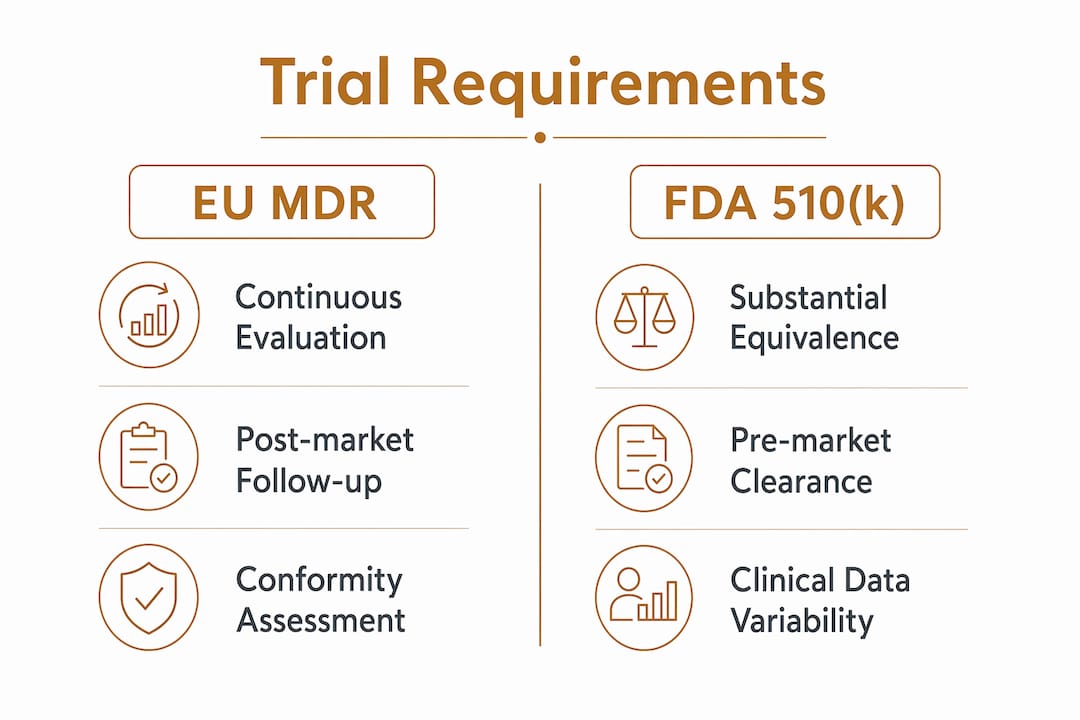
| Framework | Requirement | Trial type typically needed |
|---|---|---|
| EU MDR | Continuous clinical evaluation with PMCF | RCTs, literature review, equivalence data |
| FDA 510(k) | Substantial equivalence to predicate device | Published data or limited clinical testing |
| FDA De Novo / PMA | Independent safety and efficacy demonstration | Controlled clinical studies with defined endpoints |
| CE mark | Compliance with EU MDR clinical evaluation | Varies by device risk classification |
Crucially, not every device requires a new clinical investigation. Manufacturers can rely on existing literature and equivalence data if they can justify that reliance. This is why two devices with similar technology can have very different depths of clinical evidence behind them. The regulatory floor is not the same as the scientific gold standard.
What standards make clinical claims in beauty devices credible?
Knowing that a trial exists is not enough. The design and execution of that trial determine whether its conclusions are worth trusting.
Credible trials use objective, clinically validated endpoints rather than subjective questionnaires. Instruments such as TEWL (transepidermal water loss) measurement, profilometry, and VISIA complexion analysis produce quantifiable data that is not influenced by how a participant feels about a product. A trial measuring “skin looks better” is not the same as one measuring a statistically significant reduction in roughness depth using calibrated imaging. Experts evaluate trials by whether endpoints use validated instruments and include meaningful comparators rather than self-reported impressions.
Sample size and duration are equally critical. A trial with 12 participants over two weeks cannot generate statistically meaningful conclusions about long-term safety or efficacy. Some device mechanisms require months of regular use before measurable benefits appear. A 2026 randomised double-blind trial of a wearable device for hair loss demonstrated significant hair density improvements at six months, with mild and infrequent adverse events. That six-month window is not arbitrary. It reflects the biological timeline of the hair growth cycle.
Peer review and funding transparency matter too. A study published in a peer-reviewed dermatology journal has been independently scrutinised for methodological flaws. A white paper published on a brand’s own website has not. Funding source disclosure is equally telling. Manufacturer-funded studies are not automatically invalid, but independent replication strengthens confidence considerably.
Certifications to look for:
- CE mark: Confirms compliance with EU MDR clinical evaluation requirements
- FDA clearance or approval: Confirms the device has met US safety and efficacy standards
- ISO 10993 compliance: Indicates biocompatibility testing for devices with skin contact
- Peer-reviewed publication: Confirms independent scientific scrutiny of the trial methodology
Pro Tip: Check whether a brand’s cited study used TEWL, profilometry, or validated imaging tools as endpoints. If the primary outcome was a participant questionnaire, the evidence is weaker than the brand’s language implies.
Devices with CE mark or FDA clearance have met accepted clinical evidence requirements. That does not mean every claim the brand makes is proven, but it confirms a baseline of regulatory scrutiny that uncleared devices lack entirely. For a practical comparison of certified beauty device brands, the regulatory context behind each certification matters as much as the label itself.
How can consumers interpret clinical trial results effectively?
Reading a clinical claim critically is a skill, and it is one the beauty industry does not want you to develop. The phrase “clinically proven” appears on packaging for devices backed by rigorous RCTs and on packaging backed by nothing more than a consumer satisfaction survey. Recent ASA rulings confirm that “clinically proven” claims must be supported by robust human experimental studies with control groups and blinding. Consumer use tests without these attributes do not qualify as clinical proof.
Here is a practical framework for evaluating any clinical claim you encounter:
- Identify the study design. Was it randomised? Was there a control group? Was it blinded? A yes to all three indicates strong methodology.
- Check the sample size and duration. Fewer than 30 participants or less than four weeks of follow-up should prompt scepticism for most skin outcomes.
- Examine the endpoints. Were outcomes measured with validated instruments or self-reported surveys? Objective measures carry far greater weight.
- Verify the publication source. Is the study published in a peer-reviewed journal, or does it exist only on the brand’s website?
- Confirm regulatory clearance. Check whether the device holds FDA clearance or a CE mark, and understand what that certification actually covers.
- Look for post-market data. A device with ongoing PMCF data demonstrates that the manufacturer is monitoring real-world safety, not just pre-launch performance.
Understanding science-backed skincare evidence requires the same critical lens you would apply to any health product. The beauty device market is not uniformly regulated, and the burden of verification sits with you as the consumer.
Pro Tip: Search for the device name alongside “clinical study” or “randomised trial” in Google Scholar or PubMed. If no peer-reviewed results appear, the brand’s clinical claims are likely based on internal testing only.
Light-based devices present a specific interpretive challenge. Outcomes from LED and near-infrared devices vary considerably based on wavelength, power density, and treatment duration. A trial must match device settings to endpoints for its results to be relevant to your actual usage. A study conducted at clinical-grade power settings does not automatically validate a consumer device operating at a fraction of that output. Always check whether the trial device matches the product specification you are purchasing.
Key takeaways
Clinical trials are the only reliable mechanism for distinguishing effective, safe beauty devices from those that rely solely on marketing claims and consumer perception.
| Point | Details |
|---|---|
| Trial design determines credibility | Randomised, controlled, double-blind studies produce the most reliable evidence for beauty device claims. |
| Regulatory frameworks set minimum standards | EU MDR requires continuous clinical evaluation; FDA clearance confirms a baseline of safety and efficacy evidence. |
| “Clinically proven” is not self-certifying | ASA rulings confirm the phrase requires robust human studies with controls and blinding to be legally valid. |
| Objective endpoints outweigh surveys | Validated instruments such as TEWL and profilometry provide measurable, unbiased outcome data. |
| Post-market follow-up matters | PMCF data confirms that a device’s safety and efficacy profile holds up under real-world conditions over time. |
Why clinical trials in beauty tech deserve more scrutiny than they get
The phrase “clinically proven” has become so overused that it has lost almost all meaning for most consumers. I have reviewed dozens of brand-published studies over the years, and the pattern is consistent. The headline claim is bold. The methodology footnote is buried. The sample size is 22 people. The endpoint is a questionnaire.
What frustrates me most is that genuinely rigorous trials do exist in this space. The 2026 NIR LED study using PRIMOS and VISIA imaging is exactly the kind of work the industry should be producing as standard. The hair loss wearable trial with a six-month sham-controlled design is another. These studies are not unicorns. They are achievable. The problem is that the market does not currently reward brands for producing them, because consumers rarely ask.
Clinical evaluation under EU MDR is a living dossier, not a one-time submission. That framing is the most useful mental model I can offer you. A device’s evidence base should grow over time as post-market data accumulates. If a brand cannot point you to updated clinical data beyond their original launch study, that is a gap worth questioning.
My practical advice is this: prioritise devices with peer-reviewed publications, FDA clearance or CE marks, and transparent PMCF commitments. Treat everything else as a hypothesis until the evidence catches up. Your skin deserves the same standard of proof you would expect from any other health product.
— Adam
Explore clinically supported beauty devices at Glowera
Glowera curates beauty tech devices that meet genuine clinical evidence standards, not just marketing benchmarks. Every product in the collection is selected with safety and efficacy as the primary criteria, sourced from international brands with documented regulatory clearances. Whether you are exploring LED light therapy devices backed by peer-reviewed studies or microcurrent devices with clinical trial support, Glowera provides the product detail and certification information you need to make a genuinely informed decision. Browse the full beauty tech range and filter by technology, brand, and clinical evidence to find the right device for your skin goals.
FAQ
What is the role of clinical trials in beauty devices?
Clinical trials for beauty devices are controlled studies that verify whether a device is safe and effective through objective measurement. They provide the scientific foundation for regulatory approvals such as FDA clearance and CE marks, and distinguish evidence-based devices from those relying on marketing claims alone.
Are clinical trials required before a beauty device can be sold?
Regulatory requirements vary by market. Under EU MDR, manufacturers must conduct continuous clinical evaluation, though not every device requires a new clinical investigation if existing literature and equivalence data are sufficient. FDA clearance via the 510(k) pathway may also rely on published data rather than new trials.
What does “clinically proven” actually mean on a beauty device?
The phrase requires backing by robust human experimental studies with control groups and blinding to be considered valid. Consumer use tests or satisfaction surveys without these design elements do not meet the standard, as confirmed by recent ASA rulings in the UK.
How do I know if a beauty device has credible clinical evidence?
Check whether the device holds FDA clearance or a CE mark, search for peer-reviewed publications using the device name on PubMed or Google Scholar, and verify that the trial used objective endpoints such as TEWL or profilometry rather than self-reported questionnaires.
Why does post-market clinical follow-up matter for beauty devices?
PMCF studies collect real-world safety and efficacy data after a device launches, confirming that pre-market results hold under everyday conditions. Under EU MDR, PMCF is a mandatory part of the continuous clinical evaluation process, not an optional addition.