The at-home skincare device market has never been more crowded, and if you’ve spent time trying to compare international beauty device brands, you already know the frustration. Hundreds of devices, dozens of technologies, and marketing claims that all sound equally compelling. The global photon skin rejuvenation market was valued at USD 1.5 billion in 2024, projected to reach USD 3.2 billion by 2033. That growth reflects genuine consumer demand, but it also means more noise to cut through. This guide gives you the tools to make a confident, informed choice.
Table of Contents
- Key takeaways
- Understanding beauty device categories
- Criteria to compare beauty device brands
- Brand comparison: leading international devices
- How to choose and integrate a beauty device
- My honest take on choosing beauty devices
- Explore Glowera’s curated beauty device range
- FAQ
Key takeaways
| Point | Details |
|---|---|
| Technology matters more than brand names | Understand what each device type does before comparing brands, so you assess results rather than reputation. |
| Usability drives long-term results | A device you use consistently every day will outperform a sophisticated one you rarely pick up. |
| FDA clearance is not the full picture | Clearance confirms safety standards but does not guarantee clinical efficacy; look for clinical trial data. |
| App dependency is a real risk | Devices that rely entirely on cloud-based apps can become obsolete; prioritise those with offline modes. |
| Price should include consumables | Gels, replacement heads, and accessories add significantly to the total cost of ownership over time. |
Understanding beauty device categories
Before you can meaningfully compare international beauty device brands, you need a working understanding of the main technologies available. Each category targets different skin concerns, and choosing the wrong type is one of the most common purchasing mistakes.
Here is a summary of the core device categories:
| Category | Technology | Primary skin benefit | Typical usage frequency |
|---|---|---|---|
| LED light therapy | Red, blue, near-infrared light wavelengths | Collagen stimulation, acne reduction, inflammation control | 3–5 sessions per week |
| Microcurrent | Low-level electrical currents | Facial muscle toning, immediate lifting effect | Daily or alternate days |
| IPL (Intense Pulsed Light) | Broad-spectrum light pulses | Hair removal, pigmentation, sun damage | Every 2–4 weeks initially |
| Radiofrequency | Heat energy targeting dermal layer | Skin tightening, wrinkle reduction | 1–3 times per week |
| Cold and heat therapy | Thermal energy application | Depuffing, product absorption, circulation boost | Daily as part of routine |
LED red light therapy devices are widely recommended for consistent, non-invasive results with a lower risk of misuse compared to electrical stimulation tools. They are a strong starting point for those new to beauty technology. For IPL devices, it is worth knowing that effectiveness depends on pigment contrast. Devices with built-in skin tone sensors are strongly preferred, as they prevent use on unsuitable skin tones and reduce the risk of burns.
Radiofrequency tools sit at the premium end of the at-home market, often mimicking clinic-grade treatments. Cold and heat therapy wands, by contrast, are accessible entry points that complement any existing skincare routine without significant technique requirements.
Criteria to compare beauty device brands
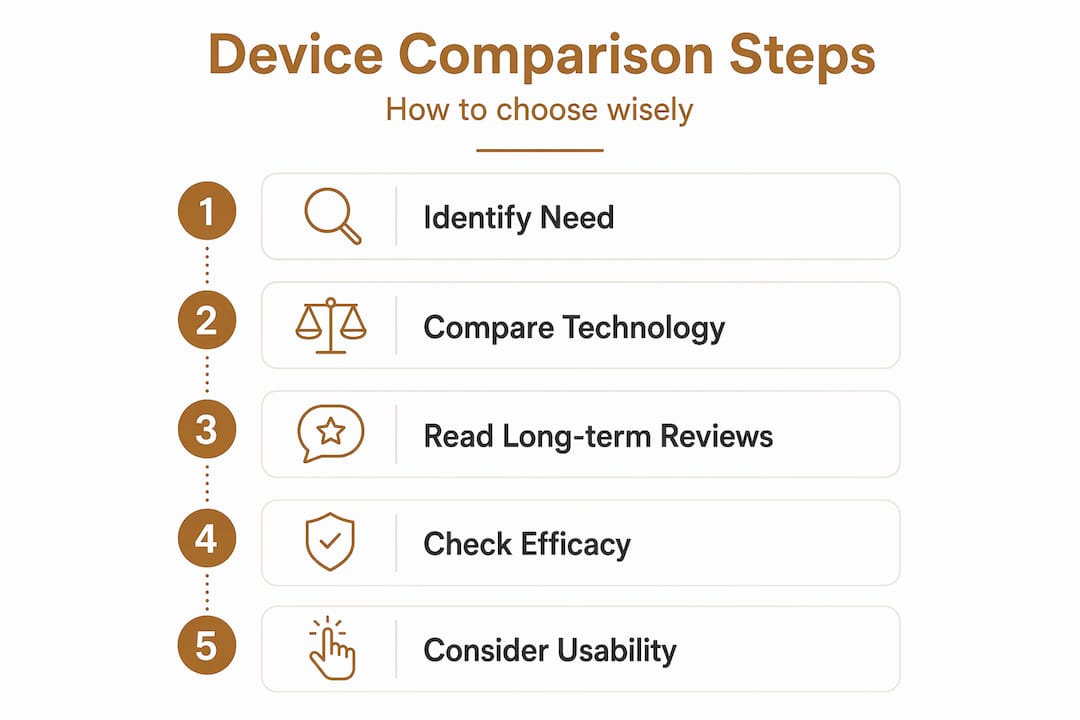
Once you know which device category interests you, the real comparison work begins. Here is what genuinely separates strong brands from overhyped ones.
- Clinical validation. Does the brand publish peer-reviewed studies or independent clinical trial results? Marketing claims and before-and-after photographs are not sufficient evidence.
- Safety features. Look for skin tone sensors, automatic shut-off mechanisms, and where relevant, FDA clearance. Note that FDA clearance confirms safety but does not guarantee clinical efficacy.
- Ease of use and portability. Portability and ease of use frequently influence long-term user compliance more than peak device power or feature richness.
- App dependency. Devices that rely entirely on companion apps carry a real obsolescence risk. If the brand discontinues app support, your device loses core functionality. Prioritise brands that offer comprehensive offline modes.
- Product range and innovation. A brand that has invested across multiple device categories, with iterative improvements, signals a genuine commitment to technology rather than a one-product marketing exercise.
- Total cost of ownership. Factor in conductive gels, replacement cartridges, and charging accessories when comparing price points. Some devices look affordable upfront but accumulate significant ongoing costs.
- Customer support and warranty. International brands sold through unverified channels frequently offer no local after-sales support. This matters considerably when you encounter a fault twelve months in.
Pro Tip: Before purchasing any device, search for independent long-term reviews, not just initial unboxings. Users who have owned a device for six months or more will surface issues that new reviewers never encounter.
Brand comparison: leading international devices
The following brands represent the current front-runners across global beauty technology. Each occupies a distinct market position.
| Brand | Device type | Key technology | Approximate price point | Best suited for |
|---|---|---|---|---|
| ZIIP Halo | Microcurrent and nanocurrent | Dual-current cellular stimulation | Premium (AED 1,500+) | Anti-ageing, tone and lift |
| NuFACE | Microcurrent | Single-frequency muscle toning | Mid-premium (AED 800+) | Facial contouring, first-time users |
| LYMA | Photobiomodulation laser | Gene expression modulation | Ultra-premium (AED 5,000+) | Advanced anti-ageing |
| Medicube | LED and radiofrequency | K-beauty multi-technology | Mid-range (AED 500+) | Brightening, pore refinement |
| FOREO | Sonic cleansing, LED, microcurrent | Multi-mode sonic and light therapy | Mid-range (AED 400+) | Daily cleansing and maintenance |
| Silk’n | IPL and radiofrequency | Multi-technology home devices | Accessible (AED 300+) | Hair removal, body use |
ZIIP Halo stands apart in the microcurrent space. Its combined microcurrent and nanocurrent technology reduces wrinkles by 28% and spots by 44% in clinical data, with 97% of users seeing immediate lifting. Nanocurrent addition promotes deeper cellular regeneration that standard microcurrent alone cannot achieve. The caveat is app dependency. The ZIIP device leans heavily on its companion app for treatment programmes, making offline functionality limited.
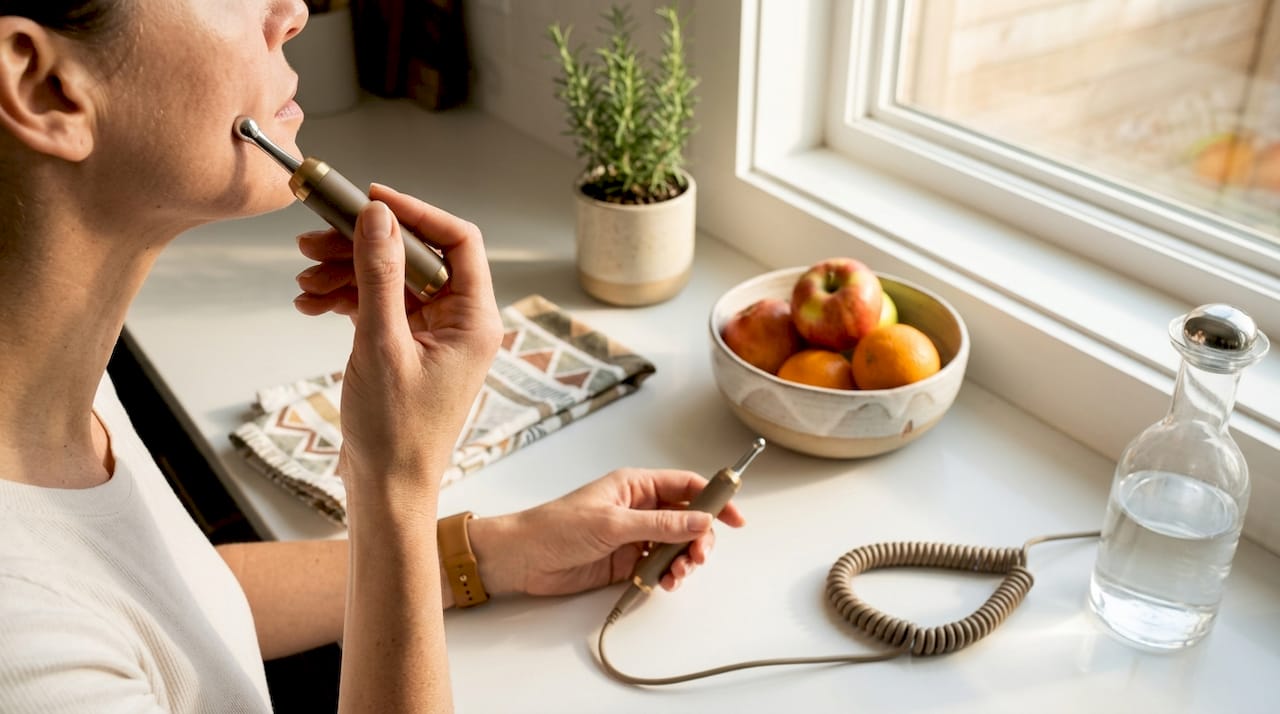
NuFACE is arguably the most accessible entry point into facial toning devices. It delivers a reliable, single-frequency microcurrent experience without the complexity of dual-current systems. Results are more surface-level than ZIIP but the learning curve is gentler, which counts for a great deal in terms of consistency.
LYMA Laser PRO occupies its own category entirely. It uses photobiomodulation that supercharges cellular mitochondria, triggering gene expression changes without any tissue damage. This is the closest at-home treatment available to professional clinic devices, and the price reflects that. It is not for the casual buyer, but for those committed to long-term skin health, it represents a genuine paradigm shift away from injury-based remodelling.
Medicube represents the strongest value proposition in K-beauty technology, and if you want to explore Korean skincare devices specifically, it is a compelling starting point. Their Age-R range combines radiofrequency and electroporation in compact, well-designed devices priced accessibly relative to Western counterparts.
FOREO excels at combining daily cleansing with active skincare treatment in a single device. The silicone brush design requires no replacement heads, which removes an ongoing consumable cost entirely. Their Luna and Bear ranges cater to different treatment depths.
Silk’n is the go-to for those prioritising IPL and body-use devices. Their at-home IPL handles a broad range of uses across hair removal and skin rejuvenation, though you must verify compatibility with your specific skin tone before purchasing.
How to choose and integrate a beauty device
Selecting the right device is only half the work. Getting results from it requires a realistic approach from day one.
- Assess your primary skin concern. Not your general wish list, your single most pressing concern. Devices that claim to do everything tend to do nothing particularly well. Target your investment.
- Match the technology to your lifestyle. If your mornings are rushed, a ten-minute LYMA session is not going to happen consistently. A thirty-second FOREO cleanse might. Consistent daily use of a simpler device will outperform sporadic sessions with a sophisticated but cumbersome one.
- Set a realistic treatment timeline. Most devices require four to twelve weeks of consistent use before visible changes appear. If you expect results in two weeks, you will give up too early.
- Learn the contraindications before you buy. Active breakouts, certain skin conditions, metallic implants near the treatment area, and pregnancy are common contraindications across multiple device categories. Check the device manual and your dermatologist’s guidance.
- Build your routine around the device. Plan when you will use it before you receive it. Morning or evening? Pre-serum or post-cleanse? Devices that are not anchored to an existing habit are the first things to be abandoned.
- Budget for consumables from the start. Conductive gels, replacement cartridges, and charging cables need to be factored in. What looks like an affordable device brand can become expensive over twelve months.
Pro Tip: Take dated reference photographs of your skin before beginning any device treatment. This is the only objective way to assess progress, and it protects you from the common trap of expecting more than a device can realistically deliver.
My honest take on choosing beauty devices
I’ve spent considerable time reviewing how people actually use beauty devices versus how brands expect them to be used, and the gap is revealing. Most people who feel let down by a device did not fail to use it correctly. They bought a device that was never a realistic fit for their actual routine.
The brands that attract the loudest criticism are often not the ones with inferior technology. They are the ones whose devices demand the most from the user in terms of time, technique, or app interaction. I have found devices with offline functionality to be significantly more reliable long-term investments than app-dependent counterparts.
My other strong opinion: do not buy on brand hype alone. LYMA is a phenomenal piece of technology, but most users would see equally meaningful progress from a well-chosen LED mask used five times per week. The price gap between those two options is enormous.
The brands I find most trustworthy in the global beauty technology space are those who publish their clinical data openly, invest in offline usability, and have not over-promised on timelines. Medicube stands out in this regard at a mid-range price point. NuFACE still delivers for beginners because of its simplicity. And for anyone serious about deep cellular anti-ageing, ZIIP’s dual-current approach is technically ahead of most of the competition.
Patience is genuinely the underrated factor in all of this. No device from any brand will outperform a consistent, committed approach to using a good device correctly.
— Adam
Explore Glowera’s curated beauty device range
If you have been trying to compare international beauty device brands and still feel uncertain about which device suits your skin and lifestyle, Glowera takes the guesswork out of the process. As a trusted source for premium beauty technology in Saudi Arabia, Glowera stocks authenticated devices from the world’s leading brands, each selected for proven technology and genuine results. You can browse the full catalogue with confidence, knowing every device ships locally with verified authenticity and expert after-sales support. Whether you are drawn to LED therapy devices, microcurrent tools, or K-beauty technology, Glowera’s team is available to guide your choice based on your specific skin concerns and budget.
FAQ
What is the best device type for anti-ageing at home?
Microcurrent and photobiomodulation laser devices currently lead for anti-ageing results. ZIIP Halo’s dual-current system reduces wrinkles by 28% in clinical data, whilst LYMA’s laser works at a cellular gene expression level without tissue damage.
Does FDA clearance mean a beauty device is effective?
No. FDA clearance confirms safety standards but does not guarantee clinical efficacy. Always look for brands that publish independent clinical trial results alongside any regulatory status.
How long before you see results from beauty devices?
Most beauty devices require four to twelve weeks of consistent use before visible changes are apparent. Consistent daily use of a well-matched device will deliver better long-term outcomes than sporadic use of a more advanced one.
Is app dependency a problem with beauty devices?
It can be. Devices that rely entirely on cloud-connected apps risk becoming obsolete if the brand discontinues support. Prioritise devices that offer comprehensive offline or manual modes for long-term usability.
Are IPL devices safe for all skin types?
No. IPL works by targeting pigment contrast between skin and hair, and devices used on unsuitable skin tones can cause burns or provide no benefit. Choose IPL devices with built-in skin tone sensors that prevent use on incompatible tones automatically.