When you unbox a premium beauty device and scan the packaging for clues about what it actually does, you will almost always encounter numbers: milliwatts per square centimetre, joules, or treatment time in minutes. Most consumers in Saudi Arabia buying at-home skincare technology see these figures and either ignore them or assume bigger means better. Understanding what does beauty device energy output mean is not just a matter of technical curiosity. It determines whether your device delivers real skin benefits, whether it is safe for regular use, and whether you are actually getting value from the investment.
Table of Contents
- Understanding energy output: what does it really mean?
- How different beauty devices deliver energy to your skin
- Why energy output matters for skin safety and results
- How to interpret energy output when choosing at-home beauty devices
- Why focusing on “dose at the skin” rather than raw power changes the way we pick beauty devices
- Explore scientifically formulated beauty devices trusted in Saudi Arabia
- Frequently asked questions
Key Takeaways
| Point | Details |
|---|---|
| Energy output basics | Energy output measures how much energy a device delivers to your skin and is key to treatment effectiveness. |
| Dose matters most | The total energy dose received during treatment depends on rate and time, not just headline power numbers. |
| Different technologies vary | LED, microcurrent, RF, and HIFU devices deliver energy differently, affecting skin layers and treatment goals. |
| Controlled energy ensures safety | Proper dose control balances efficacy and safety, avoiding discomfort or skin damage. |
| Smart device choice | Understanding energy output helps you pick devices that deliver consistent, clinically backed skin benefits. |
Understanding energy output: what does it really mean?
Energy output in beauty devices comes down to two core measurements that work together. On their own, neither tells the full story.
Irradiance is the rate at which energy is delivered to a surface, expressed in milliwatts per square centimetre (mW/cm²). Think of it like water pressure from a tap. A high-pressure tap delivers water fast, but that does not tell you how much water you have used overall.
Energy density, also called dose, is the total energy delivered over the course of a session, expressed in joules per square centimetre (J/cm²). This is the amount of water that has actually gone into the bucket. As the irradiance and energy density guide confirms, energy density (J/cm²) is the most important parameter linked to biological outcomes in light-based treatments.
The formula connecting these two measurements is straightforward:
Dose (J/cm²) = Irradiance (mW/cm²) × Treatment time (seconds) ÷ 1,000
So a device with an irradiance of 50 mW/cm² used for 600 seconds delivers a dose of 30 J/cm². A device with double the irradiance used for half the time delivers the same dose. The headline power number alone tells you very little.
Here is what this means practically:
- A device with high peak irradiance but a 5-minute maximum treatment time may deliver less dose than a lower-powered device used for 20 minutes.
- Average irradiance across the treatment area matters more than peak output at the light source.
- Dose is cumulative, so consistent sessions over weeks build the biological effect.
When comparing beauty device energy outputs, always look for both irradiance and recommended treatment time together.
Pro Tip: Ask the brand for the average irradiance at skin level, not the output at the light source. The difference can be significant depending on the device’s design and the distance between the emitter and your skin.
How different beauty devices deliver energy to your skin
Beauty device energy explained across technologies reveals just how different each approach is, even though the underlying principle of controlled energy delivery to skin tissue remains the same. How energy output affects beauty devices of each category depends entirely on the energy type and the mechanism of delivery.
| Technology | Energy type | Penetration depth | Primary skin effect |
|---|---|---|---|
| LED therapy | Light (photons) | Superficial to mid-dermis | Mitochondrial stimulation, ATP production |
| Microcurrent | Low electrical current | Epidermis and dermis | Muscle re-education, protein synthesis |
| Radio frequency (RF) | Electromagnetic heat | Dermis (1 to 4 mm) | Collagen remodelling, tissue tightening |
| HIFU | Focused ultrasound | SMAS layer (4.5 mm+) | Thermal coagulation, structural lift |
LED devices deliver photons at specific wavelengths (typically 630 nm for red and 415 nm for blue). These photons are absorbed by mitochondria in skin cells, increasing adenosine triphosphate (ATP) production and accelerating tissue repair. The energy is non-thermal, which means no heat is involved.
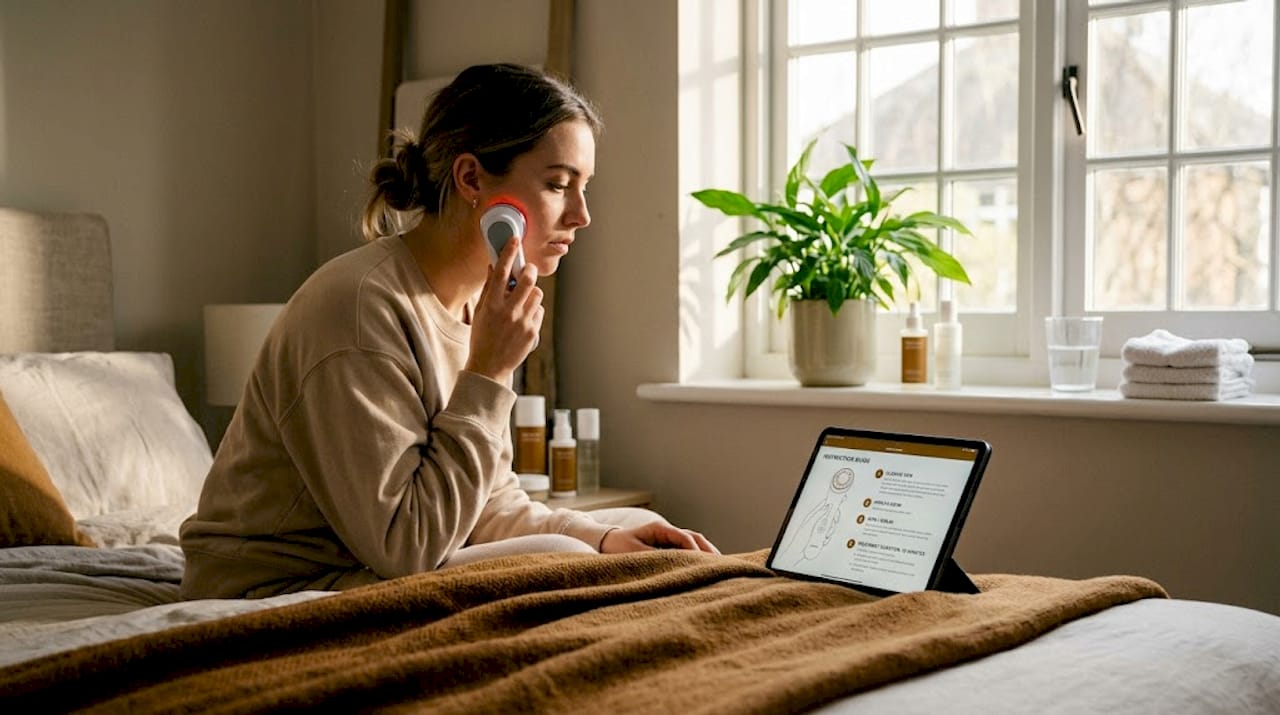
Microcurrent devices deliver currents typically below one milliampere, which closely mimic the body’s natural bioelectric signals. These micro-pulses stimulate fibroblasts and can promote collagen and elastin production at the cellular level. The precision of current delivery matters enormously here.
Radio frequency devices use electromagnetic energy to generate controlled heat in the dermis. This heat triggers a wound-healing response that stimulates new collagen formation. Depth and temperature are the critical parameters. As research into HIFU radio frequency and laser energy comparison confirms, different technologies use specific energy types with varying penetration and temperature profiles to stimulate skin renewal.
HIFU, even in at-home adaptations, focuses ultrasound energy at a precise depth to create tiny thermal coagulation points that trigger the body’s repair response at a structural level.
- Each technology has a specific energy parameter that must be controlled for safe, effective results.
- Skin type, melanin content, and skin condition can influence how each energy type is absorbed.
- Never assume one technology’s effective dose applies to another.
Pro Tip: For daily-use at-home devices, LED is the most forgiving in terms of dosing errors. RF and microcurrent devices require more attention to treatment protocols because their energy interacts with tissue differently.
Why energy output matters for skin safety and results
The significance of energy output in skincare is not a branding exercise. Dose control is the difference between a device that genuinely improves skin over time and one that either does nothing or causes discomfort with repeated misuse.
Here is where a common misconception deserves correcting. More intensity does not equal faster or better results. Skin response to energy stimulation is not linear. Too little energy produces no meaningful cellular response. Too much can disrupt natural bioelectrical balance in microcurrent devices, or cause temporary erythema (redness) and discomfort in RF treatments.
The importance of controlled energy in microcurrent devices becomes especially clear when you consider that the body’s own bioelectric signals operate in specific current ranges. Delivering too much current does not amplify the benefit. It creates interference.
Understanding beauty device specifications requires looking beyond power and asking what parameters the device uses to control delivery. Temperature limits, current ceilings, and automatic dose shutoffs are features that protect you while ensuring consistent results.
The benefits of beauty device energy levels, when properly controlled, are cumulative:
- Week one to two: Cellular processes begin responding to repeated stimulation.
- Week three to four: Visible improvements in skin tone or texture begin to emerge.
- Week six to twelve: Structural changes (firming, improved elasticity) become measurable.
The pattern only holds when dosing is consistent. Irregular use breaks the cumulative chain and resets the biological response.
Pro Tip: Treat your beauty device sessions like a prescribed course rather than an occasional treat. The skin’s response to energy stimulation follows the same rules as exercise adaptation. Frequency and consistency outperform occasional high-intensity sessions.
Manufacturers who list average irradiance at skin surface, recommended treatment time, and the resulting dose calculation are telling you something important: they have designed for real clinical parameters, not just impressive-sounding specifications.
How to interpret energy output when choosing at-home beauty devices
Knowing how to choose beauty devices based on energy requires translating specifications into practical expectations. Here is a step-by-step approach for making a well-informed purchase decision.
- Find the average irradiance value. Look for mW/cm² listed in the device specifications. If only peak output is listed, this is a limitation of the product information.
- Note the recommended treatment time. In seconds or minutes, this figure allows you to calculate approximate dose.
- Calculate or estimate dose. Use the formula: Irradiance × time ÷ 1,000. Compare this figure against published ranges for the technology you are considering.
- Check for controlled parameters. Temperature cutoffs for RF devices, current limits for microcurrent tools, and automatic session timers are signs of responsible engineering.
- Look for clinical validation. Devices tested in independent studies or with published dosing protocols are more likely to deliver consistent results.
- Match the technology to your goal. LED for repair and radiance, RF for tightening, microcurrent for lifting and firming, HIFU-inspired devices for structural work.
Research confirms that energy-based devices stimulate skin renewal by activating mitochondria, fibroblasts, and other repair pathways through precise energy delivery over weeks of consistent use.
When browsing K-beauty tech devices, this framework helps you look past aesthetics and evaluate what the device will actually do to your skin.
Additional points to consider:
- Energy efficiency in beauty tools matters for practical use. A device that drains quickly or runs inconsistently may not deliver its rated parameters throughout the session.
- What is beauty device wattage? It is the total electrical power consumed, not necessarily the energy delivered to skin. These two figures can differ significantly depending on how efficiently the device converts power to skin energy.
- Pairing devices with compatible serums or conductive gels can affect how energy is absorbed at the surface.
Pro Tip: When evaluating a new device, search for its clinical study or dosing protocol in published research or brand documentation. Reputable brands make this information available. If a brand only quotes wattage without any skin-level data, treat that as a signal to look deeper before purchasing.
Why focusing on “dose at the skin” rather than raw power changes the way we pick beauty devices
There is a deeply ingrained habit in consumer electronics that has carried into beauty tech: the assumption that higher numbers mean better performance. It applies to screen resolution, processor speed, and now to beauty device specifications. This habit does not serve you when buying skincare technology, and it is worth examining why.
Raw power output is a manufacturer-side measurement. It tells you what comes out of the device. Dose at the skin is a consumer-side measurement. It tells you what your skin actually receives. These are not the same thing, and the gap between them is where marketing often operates.
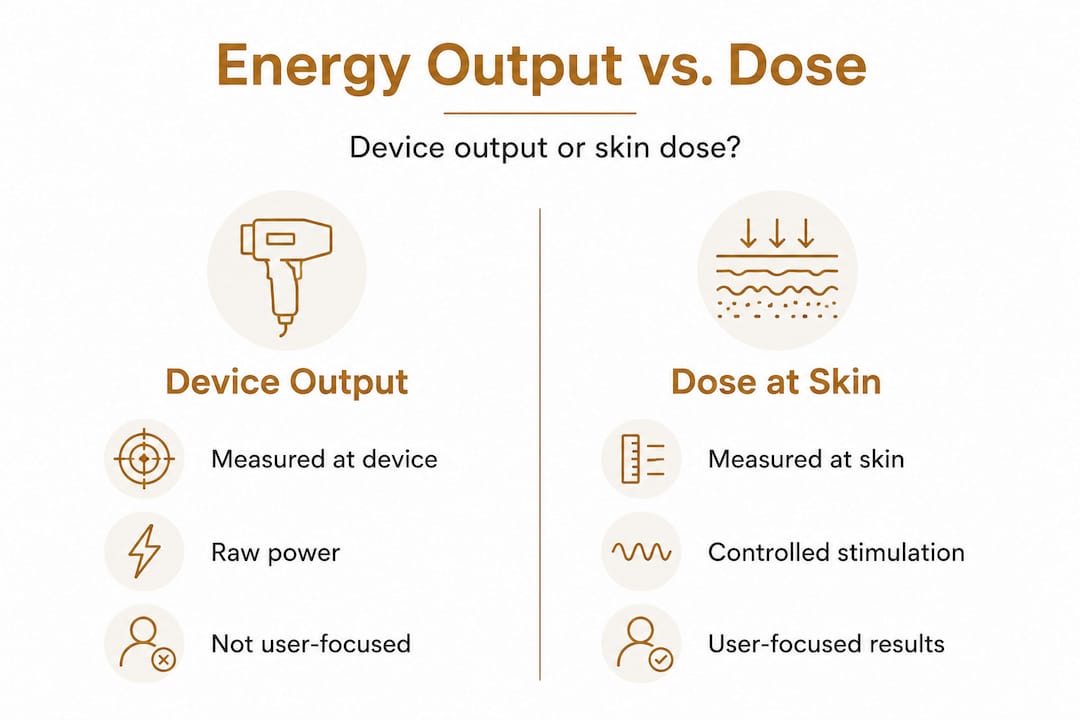
As the irradiance and energy density guide makes clear, premium at-home users should think in terms of controlled stimulation parameters and dose at the skin to accurately predict treatment outcomes. A 100 mW/cm² device used incorrectly delivers a worse result than a 30 mW/cm² device used with a proper protocol.
This perspective shifts the responsibility back to brands in a useful way. When consumers start asking for dose data, brands are pushed to provide it, which in turn drives better product engineering. Dose-focused device selection insights reflect this evolution in how the skincare tech industry is beginning to communicate about efficacy.
The most meaningful improvement in at-home beauty technology over the next few years will not be higher power. It will be smarter dose control, adaptive energy delivery based on skin response, and clearer consumer guidance on what parameters actually achieve specific results. Buying with this mindset now puts you ahead of the marketing cycle.
Explore scientifically formulated beauty devices trusted in Saudi Arabia
You now have a framework for reading beauty device specifications with genuine confidence. The natural next step is applying it to devices that are actually available for delivery across Saudi Arabia, backed by clinical science and expert guidance.
At Glowera, the collection is built around controlled energy delivery across all major beauty tech categories. Browse LED light therapy devices with specified wavelengths and treatment protocols, explore microcurrent devices engineered for precise current delivery, or consider the CurrentBody RF radio frequency skin tightening device for clinically validated tightening technology. The full K-beauty tech devices range brings together the most scientifically considered at-home tools available in the market today, all supported by local delivery and knowledgeable aftercare guidance.
Frequently asked questions
What is energy output in beauty devices?
Energy output refers to the amount and intensity of energy a device delivers to the skin, measured through irradiance (mW/cm²) and energy density (J/cm²), where energy density is the most important parameter linked to biological outcomes.
Why does treatment time matter along with energy output?
Treatment time directly determines total dose because dose equals irradiance multiplied by time, divided by 1,000, so a short session at high irradiance may deliver far less skin-level energy than a longer session at moderate output.
Are higher energy outputs always better for skin results?
No. Skin response does not increase linearly with intensity, and excessive energy can reduce comfort, disrupt bioelectrical balance, and lead to inconsistent use, making optimal dosing and controlled parameters far more valuable than raw output.
How do different devices use energy to improve skin?
Each device type uses a specific energy form to activate different cellular processes: energy-based devices stimulate skin renewal by engaging mitochondria, fibroblasts, and repair pathways, with effects building progressively over weeks of consistent treatment.
What should consumers in Saudi Arabia look for when choosing energy-based beauty devices?
Prioritise devices that specify average irradiance and recommended treatment time so you can estimate real skin-level dose, confirm the device has controlled energy parameters and clinical validation, and match the technology to your specific skin goals for safe, measurable results.